
Making merit with her family from the guest's side: what tham bun means, what a non-Buddhist partner can join, dawn alms and what to bring, birthdays and holy days, the temple dress code, and what changed on temple money and animal release, with what 135 Thai forum posters say.
 CultureChinese New Year in Thailand With Her Thai-Chinese Family27 min read
 CultureThai Food Culture: Eating With Her Family25 min read
 CultureThai Father’s Day: What to Give Her Father19 min read
 CultureValentine’s Day in Thailand: What She May Expect29 min read
 CultureHow to Say Hello in Thai: Greeting Her Family25 min read
Contents · 15 sections
Making merit in Thailand (tham bun) means doing good deeds, and with her family it will most likely mean giving: food for the monks at dawn, or a temple visit on a birthday or holy day. You can go even if you are not Buddhist. Ask her what her family does, and join what your own faith allows.
Before your first visit:
- Ask her which acts her family does and which of them she would like you at.
- You do not have to give anything. If you want to, ask her what the family brings or what the temple needs; a guest does not have to give cash.
- Cover your shoulders and knees, and ask her what the family wears.
- Agree with her beforehand which parts you will join, which you will watch and how you can help.
- Take your shoes off when the family does, and keep the soles of your feet pointing away from the monks.
You do not owe anyone a rite you cannot do in good conscience.
The pages that rank for making merit in Thailand are written for a tourist or a believer. This page is written for the man standing at the back of her family’s temple.
We read eight threads on Pantip, a big Thai public forum, in which 135 Thai posters talk about making merit: whether a Christian may go into a temple and give alms, what to tell a husband who would rather not go with his wife’s family, how often they give alms, what goes in the bowl and whether skipping it is a sin. None of the threads is by or about a foreign man at his partner’s family temple, because our 26 searches of Pantip found none. So the counts below are Thai people describing their own families and answering people close to your spot.
What does making merit mean in Thailand?
Making merit means doing a good deed that Buddhists believe brings good results. The Thailand Foundation, a Thai public foundation, describes merit-making as resting on three bases: giving, keeping the moral precepts and training the mind 1. The Thai word is tham bun, “to make merit”.
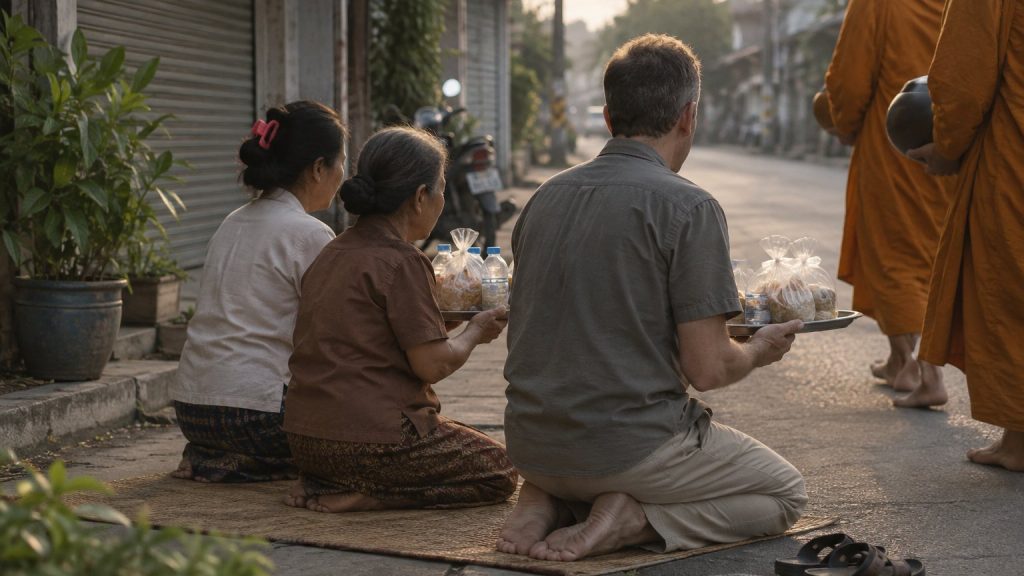
The part you are most likely to see with her family is giving. Making merit can include:
- Tak bat or sai bat: putting food in the monks’ bowls on their morning walk.
- Taking food or goods to the temple, often on a birthday or a holy day (wan phra).
- Sangkhathan: giving to the monks of a temple as a group rather than to one monk, often as a ready-made bucket of soap, toothpaste, drinks and sometimes a robe.
- Kruat nam: pouring water slowly from a small jug while the monks chant, to share the merit with others, often relatives who have died.
- Keeping the precepts on a holy day, listening to a sermon or meditating, which you may not see at all.
Is making merit only for Buddhists? The same Thailand Foundation essay says good deeds cross religious lines and names Christianity, Islam and people of no religion 1. It is an essay, not a ruling by the monks, and it speaks of good deeds in general, not of which temple acts a guest may join. That part is covered below. For Thai family life beyond the temple, see our guide to Thai dating culture.
Do you have to make merit with her family?
No. You go as her partner and a guest, and how much you join is up to you and her. Thai people themselves differ a lot on how much they do. In a 2026 Pantip thread asking how often people give alms, all 31 people who answered could be coded: 6 give daily or almost daily, 3 every week or two, 9 on holy days, birthdays or other special days, and 13 rarely or no longer. Seven of the 31 named their birthday as a day they give.