
Thai food culture from the side of a man eating with his partner's family: rice and shared dishes, spoon and fork, who starts, the serving spoon, finishing the plate, sticky rice, what "kin khao" means, and what a guest does after the meal, with counts from 231 Thai forum members.
 CultureChinese New Year in Thailand With Her Thai-Chinese Family27 min read
 CultureThai Father’s Day: What to Give Her Father19 min read
 CultureValentine’s Day in Thailand: What She May Expect29 min read
 CultureHow to Say Hello in Thai: Greeting Her Family25 min read
 CultureFarang Meaning: What Her Family Calls You and Why25 min read
Contents · 14 sections
Thai food culture at a family table usually means rice on your own plate, shared dishes in the middle, and a spoon in your right hand with the fork pushing food onto it. Wait to be invited and for the oldest person to start, use any serving spoon, and ask her about her family’s habits. Clumsy cutlery is fine.
We wrote this for a man from abroad who is about to eat with his Thai partner’s family, or who wants to know what Thai food culture looks like at home rather than on a restaurant menu. We read the public threads where Thai people argue about their own family tables on Pantip, a large Thai question forum, and counted what each person says: 231 people in 19 threads, posted from 2015 to 2026, 168 of them in 2022 or later. We also checked the table rules that published guides give, and set them against what those members say.
Nobody in that count writes as a Western man describing a meal with a Thai family. Pantip is a Thai-language forum, and what its members say about foreigners is what they report seeing. Two things a guest wants to know are thin in the threads: who serves whom, and what to say at the table. Where we could not count something, we say so rather than fill the gap with a guide’s rule.
Thai food culture at home: how is a family meal served?
Expect a pot of rice, several dishes put on the table at once, and everyone helping themselves from the middle onto their own plate of rice. Wikipedia’s page on Thai cuisine says the dishes “are all served at the same time, including the soups”, and that it is customary to provide more dishes than there are guests 1. Mixing a dish with the rice on your own plate has a name, khluk, the normal way to eat. Which rice depends on the region. Of northern food, the same page says: “As in northeastern Thailand, glutinous rice, not jasmine rice, is eaten as the staple food” 1.
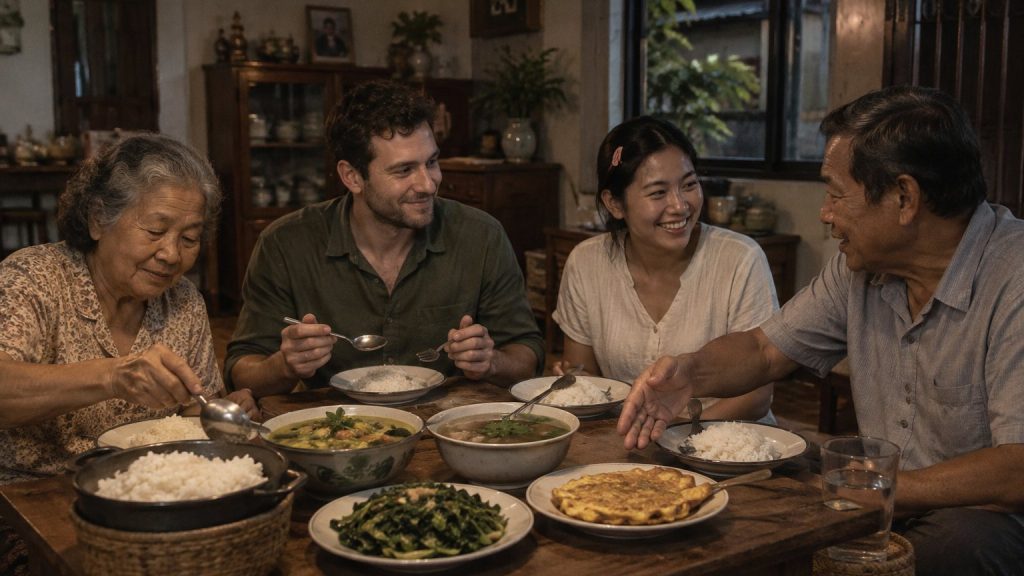
That is why Thai food culture at home is about the group more than the plate. For a meal served this way, there is no starter and no main course of your own; there is rice, and there are dishes everyone shares. Take rice first and treat each dish as something to go with it.
So sit where you are put, let the rice come to you or take a modest scoop, and look at what is in the middle before you reach for anything. If you are not sure what a dish is, ask her; naming it and asking how it is made is an easy way into the conversation.
A Thai family meal is rice on your plate and dishes in the middle for everyone. Take rice first and treat each dish as something to eat with it.
Thai table manners: what are the spoon and fork for, and where is the knife?
The spoon does the work and the fork only helps. Wikipedia puts it plainly: “Today, however, most Thais eat with a fork and spoon” 1. The same page describes the method: “The food is pushed by the fork, held in the left hand, into the spoon held in the right hand, which is then brought to the mouth” 1.
Do not expect a knife; the fork and spoon are the whole set. If something is large, cut it with the edge of the spoon. At a rice meal, chopsticks are usually not on the table. Wikipedia says “Chopsticks are mainly used in Thailand for eating Chinese-style noodle soups” and at Chinese, Japanese or Korean restaurants, while stir-fried noodles are eaten with spoon and fork 1. A guide on Thai etiquette adds that chopsticks are often used with noodle dishes “and in homes of people of Chinese ethnicity” 2. So let the table tell you: if the family brings out chopsticks, use them, and if there are none, use the spoon and fork.
If the spoon and fork feel clumsy, keep practising and do not make it the focus of the meal. In a 2025 Pantip thread a member asked why foreigners cannot use a spoon and fork; of the 16 people who answered with a view, 15 said it is a habit, not stupidity, and 1 said they found it sweet. One of them turned the question round, asking why many Thais cannot use a knife and fork the Western way. Try the push-onto-the-spoon method, keep the fork out of your mouth, and if a piece escapes, laugh with them.
The spoon in your right hand does the eating; the fork in your left pushes food onto it. In one Pantip thread, 15 of 16 Thai members who gave a view called a foreigner’s clumsiness a habit, not a failing.
Who eats first at a Thai family meal, and who calls you to the table?
Wait until the host has invited you to eat and the oldest person at the table has started. In two Pantip threads on who should start at a Thai table, from 2015 and 2026, of the 10 members who say, 9 say the older person first, and 1 says that at their own home the children start. Two more, in the 2015 thread, say the young put the first