
 Thai LanguageCute Thai Phrases for Dating: What to Say to Her and When22 min read
 Thai LanguageChapter 6: Telling Time and Making Appointments10 min readThai LanguageChapter 5: Thai phrases to use while on holiday!12 min readThai LanguageChapter 3: Asking and Answering Questions11 min readThai LanguageChapter 2: Greetings & Introducing Yourself12 min read
Contents · 5 sections
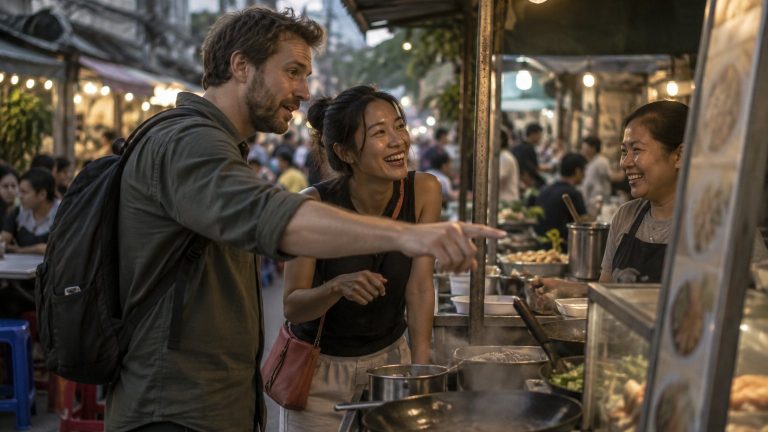
Thailand is heaven for food… And if you’re staying in Bangkok, you can find food everywhere, on the opposite side of your luxury hotel, in the market near your condominium, in the department stores, on both sides of the street in the business areas, or along the footpath to your office. But what has made Thai food so famous is not about the quantity. If you have ever eaten Thai food be- fore, you would know that ‘delicious’ or ‘yummy’ could be the underrated word. I tried to find an ad- jective to explain the taste of Thai food and have found this writer/blogger (don’t ask me which one cause I don’t remember) used the word ‘grandeur’ to describe it. Ah!… what a smart word-choice.
Similar to food of other Asian countries, Thai food is rich with the mix of herbs, spices and special seasoning which some of them could be disgusting in the eyes of foreigners. Sometimes their re- action toward Thai seasoning is hilarious. I remember once when I was cooking “Khao khai- jiao” (Thai scrambled egg on top of rice) in the dormitory’s kitchen, my Swedish friend came by in curiosity. He smelled the Thai fish sauce that I used and cried out startlingly “What is this!? It smells like SHIT!!” “Do you really eat this thing?” Yes, we do. “Nam-pla” or Thai fish sauce is an essential part of every Thai dish. Like it or not, if you’ve ever eaten Thai food, you must’ve swal- lowed it. Fortunately, my friend didn’t run out of the kitchen but if you ask me if he got a chance to eat this delicious dish or not, the answer is Noooo!!!
“Nam-pla” or Thai fish sauce is an example of unique Thai seasoning. It is amber-colored liquid extracted from the fermentation of fish with sea salt. Instead of sprinkling salt on food like the westerners do, we usually dash Nam-pla into whatever we cook to add the salty taste. Other Thai seasonings you should get to know include “Pla-ra”, the seasoning produced by fermenting fish with rice bran mostly used in Isan (northeastern) food and “Ka-pi”, the fermented shrimp paste mostly applied to southern dishes.
Besides the seasoning, we also have gross menus like “Yum khai mod-daeng” made of red ant eggs, “Gung ten” made of live shrimp, “Ka-pom yang” and “Noo-na yang” made of tree lizard and field mouse, “Lab luead” made of minced meat with blood and many more. Some of them can look horrible and even make “Som-tum Poo Pla-ra” (green papaya salad with crab and fermented fish) become completely simple. However, most of these menus are likely to be found in the arid north- eastern region where people had to eat everything they could find to survive. I don’t think we have this scarcity problem now but if we do, we can go grab MAMA at any time. It’s cheap and conve- nient.
Among those eccentric menus, “Ma-laeng Thod” and “Rod-duan” seem to be the most popular. The first one is deep fried bugs (normally grasshoppers and crickets) while the second is deep fried bamboo caterpillar. Ten years ago you would find it at the end of the soi (alley) near the con- struction sites where the labors from the northeast came to work but today, you can find them everywhere including in the department stores, mini marts (well packed in aluminum foil bags as high-protein snack), vending stands and online shops! Clearly, these menus have been leveled up and already well-known as our national dishes!
But hold on… the truth is insects and all those bizarre menus are not our everyday food. Although some of them can be found easily on the streets of Bangkok, the rest are seasonal dishes or af- fected by local people and those seeking exotic food. If you really want to know what we eat in real life, the best way is to explore our fridge and kitchen. And here are something you might find in our storehouse…
Chapter 7: Vocabulary
[bd_table]| English | Thai | English | Thai |
|---|---|---|---|
| Beef | Wua, Nuea-wua | Lime, Lemon | Ma-nao |
| Chili | Phrik | Meat | Nuea |
| Chili paste | Nam-phrik | Meat ball | Luk-chin |
| Chicken | Gai, Nuea-gai | Onion | Hom-hua-yai |
| Coconut | Ma-prao | Rice | Khao |
| Coconut milk | Ka-ti | Rice (boiled, steamed) | Khao-suay |
| Coriander | Phak-chee | Rice (sticky) | Khao-niao |
| Crab | Pu | Pepper | Phrik-thai |
| Cucumber | Tang-gwar | Pork | Moo, Nuea-moo |
| Curry paste | Krueang-gaeng | Salt | Gluea |
| Egg | Khai | Sugar | Nam-tarn |
| Fingerroot | Kra-chai | Salad | Salad, Yum |
| Fish | Pla | Scallion | Ton-hom |
| Fish sauce | Nam-pla | Shallot | Hua-hom |
| Flour | Pang | Shrimp, Prawn | Goong |
| Food | Ar-harn | Shrimp paste | Ka-pi |
| Galangal | Kha | Soybean oil | Nam-man-tua-lueang |
| Garlic | Gra-tiam | Sweet basil | Ho-ra-pha |
| Ginger | Khing | Sweet pepper | Phrik-wan |
| Holy basil | Kra-prao | Turmeric | Kha-min |
| Jasmine rice | Khao hom-ma-li | Vegetable | Phak |
| Kiffir lime | Ma-grood | Vinegar | Nam-som |
| Lemon basil | Maeng-lak | Water | Nam |
| Lemongrass | Ta-krai | Wax pepper | Phrik-yuak |
Don’t be surprised if the list is simple. The most distinctive difference between Thai and western cookery is that Thais seem to prefer rice. We usually eat rice or “Khao” with a variety of dishes which we called “Gab-khao”, preferably balancing the spicy dish with the subtle ones. You don’t have to remember all of this vocabulary, but knowing some of them will make your eating and cooking experience more enjoyable and knowledgable as well as enrich your conversation over the dinner table.
And if you want to know what you can cook using the above ingredients, here are some examples:
Khao khai-jiao: The most simple and all-time delicious, “Khai-jiao” or Thai-styled omelet is usually served with steamed rice. It’s easy to cook and saves money in your pocket. You don’t need any- thing more than “Khao-suay” (steamed rice – jasmine rice is the best), “Khai” (egg), “Nam-man tua- lueang” (soybean oil), “Nam-pla” (fish sauce) and probably a few drops of “Nam-ma-nao” (lime juice) for a perfectly fluffy egg. To make it more nutritious, you c