
What a Thai spirit house is, why many Thai homes have one and many do not, what is offered, how one is set up and moved, and what a foreign partner should and should not do, from what 99 Thai forum posters wrote.
 CultureChinese New Year in Thailand With Her Thai-Chinese Family27 min read
 CultureThai Food Culture: Eating With Her Family25 min read
 CultureThai Father’s Day: What to Give Her Father19 min read
 CultureValentine’s Day in Thailand: What She May Expect29 min read
 CultureHow to Say Hello in Thai: Greeting Her Family25 min read
Contents · 16 sections
A Thai spirit house, often a san phra phum, is a small shrine on a post outside a home or a shop, built as a home for the guardian spirit of the land. Households that keep one leave flowers, incense, water and food as a sign of respect, believing the guardian protects the place. Not every home has one.
If her family’s home has one, your part as a guest is respect, not ritual. Do not touch it, move it or take the offerings, join in only if she asks you, and ask her what her household does.
The guides that rank for the Thai spirit house explain the kinds of shrine, the offerings and the rules for where it stands. Thai people writing on Pantip, a large Thai public forum, talk about other things: whether a home needs one at all, who should set it up, what happens when one is moved, and what they think foreigners make of it. We counted what 99 of them wrote in 27 threads from 2013 to 2026. The numbers are below, beside what the published guides say, so you can see where households agree and where they differ.
What is a Thai spirit house?
A spirit house is a miniature shrine, often shaped like a small temple or a Thai house, set on a pedestal in the garden, the yard or by the gate. It is built as a place for the guardian of the land to live. A Bangkok walking-tour guide calls the san phra phum the most commonly seen kind: it stands on a single pedestal and often holds a figure of Phra Phum, the guardian himself, holding a sword or trident 1.
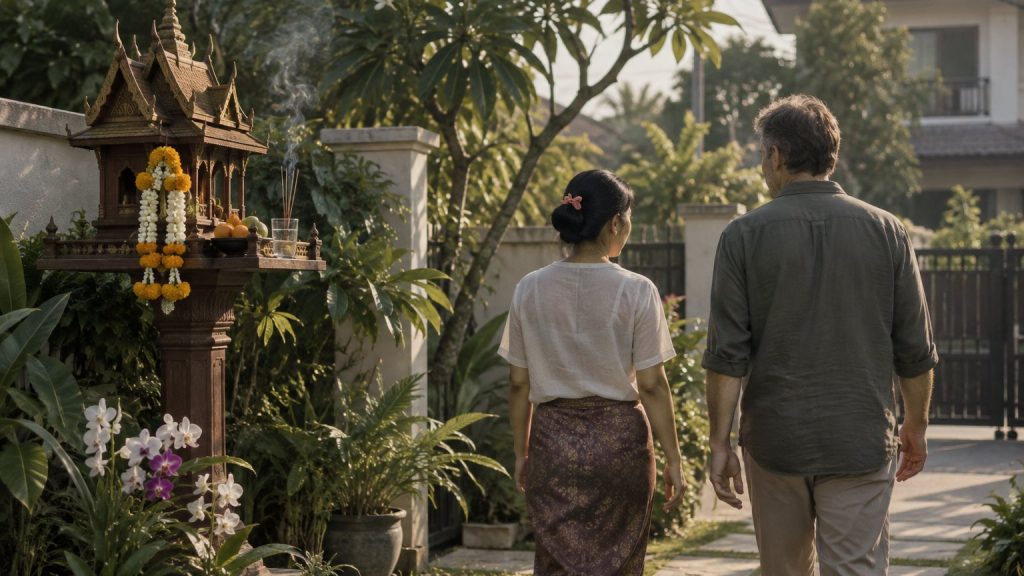
The custom is not only for tourists to look at. A 2010 ethnographic study of spirit houses in urban Thailand notes in its abstract that many house compounds in Thailand have small shrines to locality and guardian spirits 2. You will see them outside homes, offices, shops and markets.
A spirit house is not a temple, and the respect shown to it is not the same as a visit to a wat. For temple visits, alms and merit, see our guide to making merit in Thailand.
San phra phum, san ta-yai and san chao thi
Here are three names you will hear. Sources and households do not always use them the same way, so here they are in plain words.
| Name | Thai | What it is |
|---|---|---|
| San phra phum | ศาลพระภูมิ | The shrine for Phra Phum, the guardian of the land. One pedestal, often a figure holding a sword or trident |
| San chao thi | ศาลเจ้าที่ | The shrine for the spirit of the place. The Bangkok guide uses it as another name for the grandparents’ shrine; some Pantip posters keep the two apart |
| San ta-yai | ศาลตายาย | The “grandpa and grandma” shrine, for the elder spirits of the place. The name is a term of respect; they are not necessarily the family’s own grandparents. Four legs and a small ladder, figures of an old couple |
The same Bangkok guide says the grandparents’ shrine stands on four legs with a ladder in front, and that along with the grandparents’ figures you may see attendants su