
To speak Filipino as a beginner, ask her which language her family speaks at home, then learn their greetings, respect words for elders (po and opo, if they speak Tagalog) and everyday phrases. Tagalog is the home language of about 4 in 10 Philippine households, and none of the 18 teaching pages we read tells you to ask.
 TagalogTagalog Greetings: How to Greet Her Family24 min read
 TagalogLearn the Bisaya Language: Phrases and Bisaya vs Tagalog23 min read
 TagalogFilipina Girlfriend Nicknames: Filipino Pet Names by Stage31 min read
 TagalogRomantic Tagalog Phrases and Filipino Flirting Lines38 min read
 Filipino CultureFlores de Mayo: What Happens at Her Town’s Santacruzan25 min read
Contents · 14 sections
To speak Filipino as a beginner, ask her which language her family speaks at home. Then learn their greetings, respect words for elders (po and opo in Tagalog) and everyday phrases, and practise daily. Courses teach Tagalog, the home language of about 4 in 10 Philippine households; others speak Bisaya or another language, and many mix in English (Taglish).
Everything below is written for a man learning for a Filipina and her family. We read 18 of the English pages Google shows for “how to learn Tagalog”: only 2 are written for someone learning for a partner, and in the text we saved, none tells you to find out which language her family uses. You’ll find the first steps, the words you need first, how long it honestly takes, and what to do when she switches to English the moment you get stuck.
How to speak Filipino for beginners: where to start
Start with her family’s language, their greetings and their everyday phrases, and build grammar around them. Here is the order that gets you talking to the people you’re learning for:
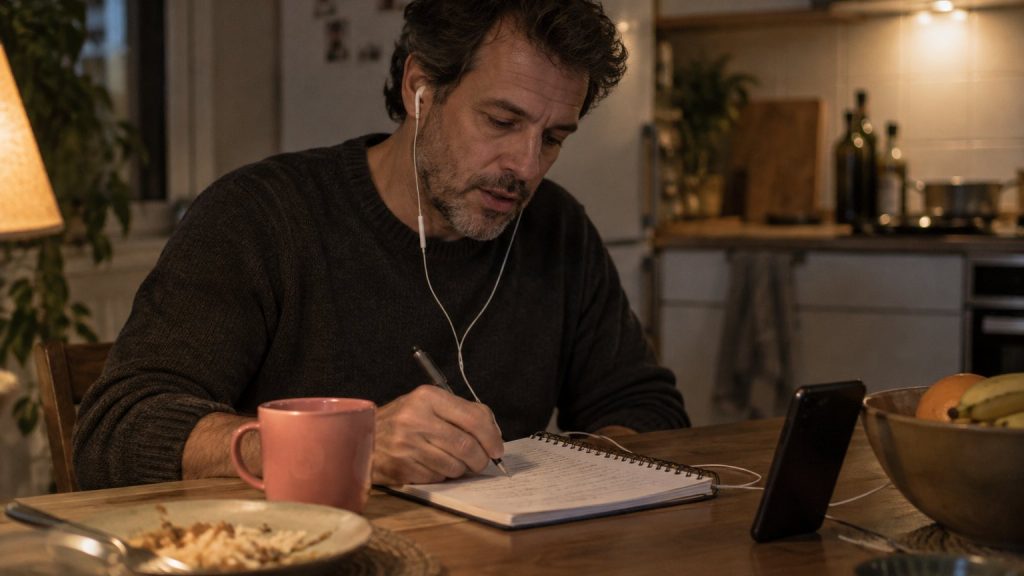
- Ask her which language her family speaks at home. Not which language she learned at school: which one her mother uses on the phone, and whether they mix in English.
- Learn the greetings and the polite words. In Tagalog that’s kumusta (how are you), salamat (thank you), and po and opo for her parents and grandparents; in another language, ask her for its greeting and its respect words. These go a long way in the first five minutes of any visit.
- Learn the phrases her family says every day. Ask her for ten, such as what her mother says when you arrive, at the table, when someone leaves. If they speak Tagalog, Kumain ka na? (have you eaten?) is a good one to ask about.
- Add the grammar you need to make your own sentences. Pronouns, question words, and how a verb shows whether an action is done, going on or still to come. Other grammar can wait.
- Listen every day. Ten minutes of real Tagalog speech, or her family’s language, lets you hear how words run together, which a word list can’t show you.
- Speak every day, with more than one person. Practise with her, and add a tutor or another speaker so your progress doesn’t rest on her alone.
None of the 18 teaching pages we read includes step 1, and it is the one that decides whether the rest of your work matches what you’ll hear at her family’s table.
Learn first the language her family speaks at home, and ask her which one that is rather than guessing.
Tagalog or Filipino: what do most Filipinos speak at home?
No single language is spoken in most Filipino homes: Tagalog is the largest, in about 4 in 10 households, and about 6 in 10 households speak another language. In the Philippine Statistics Authority’s 2020 census, T