
Utang na loob is the Filipino sense of owing gratitude, and often help in return, to someone who helped you in need. Literally a debt of the inner self, it has no agreed sum. Parents are the usual case, though Filipinos disagree whether raising a child creates one. How heavy it feels differs by woman and family, so ask her.
 Filipino CultureFlores de Mayo: What Happens at Her Town’s Santacruzan25 min read
 Filipino CultureHoly Week in the Philippines: Traditions With Her Family26 min read
 Filipino CultureFilipino Food Traditions: Eating With Her Family27 min read
 Filipino CultureWhat Is Balut? Eating It With Her Family24 min read
 Filipino CultureFilipino Time Meaning: Being Late in the Philippines19 min read
Contents · 12 sections
To take a made-up example: a niece whose aunt paid her school fees might help the aunt’s son find work years later, without anyone naming a price. If you heard the term from a Filipina or her family, it tells you what she may feel she owes them, not what anyone owes you.
What utang na loob means
Utang means debt and loob means the inner self, the part of a person that feels and remembers. Put together, utang na loob is the sense that you owe someone who helped you, and that the debt sits inside you rather than on paper. A widely read reference page gives the literal meaning as “a debt of one’s inner self” and says it is what separates it from an ordinary debt 1. In Filipino psychology it is grouped with hiya (propriety and dignity) and pakikisama (companionship) as values people use to fit in with the world around them.
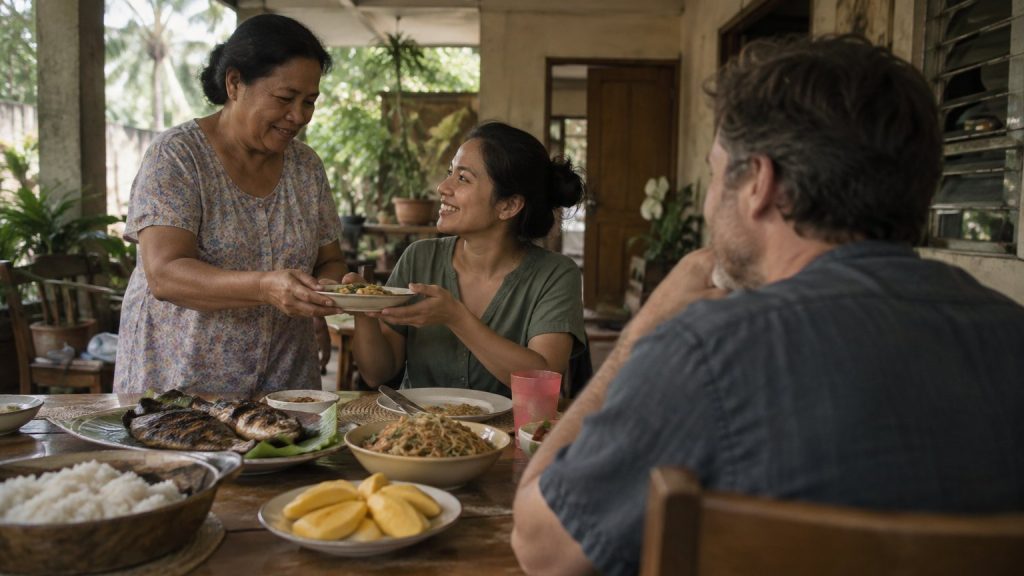
A Filipino philosophy paper puts the cause simply: helping a person in real need creates the feeling, and the greater the need, the greater the debt 2. That is why parents are the usual case: they helped when she could do nothing for herself. Some Filipino writers answer that raising a child is a parent’s job and creates no debt, so ask who actually raised and helped her rather than assuming. The same idea is why the debt can reach a friend, a relative or a doctor.
We read 14 public English pieces whose job is to explain utang na loob, found through Google and searches for published research on 25 October 2026: 5 research items, 4 pieces by Filipino writers and outlets, and 5 pages written for foreign men dating or marrying a Filipina. We coded each against a fixed list written before we started and kept the sentence behind every code.
Two of the research items were open to us only as abstracts, so for those two a zero means the abstract doesn’t say it, not that the full paper doesn’t. Across these 14 pieces, the two groups tell a man quite different things.
| What the piece says |
|---|