
The Songkran traditions from the guest's side: going home with her, the temple morning, pouring water on her elders' hands, what to bring, where the water fights fit, and the dates by year, with what 111 Thai forum posters say about their own families.
 CultureChinese New Year in Thailand With Her Thai-Chinese Family27 min read
 CultureThai Food Culture: Eating With Her Family25 min read
 CultureThai Father’s Day: What to Give Her Father19 min read
 CultureValentine’s Day in Thailand: What She May Expect29 min read
 CultureHow to Say Hello in Thai: Greeting Her Family25 min read
Contents · 16 sections
Songkran is the Thai New Year, held on 13 to 15 April, and its traditions are family ones. People go back to the family house, make merit at the temple, pour scented water over their elders’ hands for a blessing (rod nam dam hua), clean, cook and visit relatives. The street water fights are only one part.
If she has asked you to come home with her for Songkran, take the invitation seriously and talk it through with her. Before you book, ask her four things: which days her family will be at the house, whether they pour water on the elders and on which day, where you will sleep, and what you should bring. Then join the temple morning and the water-pouring where she shows you, bring something small, and keep the water play for the street and the children.
Most of the pages we read that rank for Songkran traditions are written for a visitor choosing where to watch the water fights. This page is written for the man going to her family’s house. We read 13 threads on Pantip, a big Thai public forum, in which 111 Thai posters talk about going home for Songkran, pouring water on their elders, what to take them and what foreigners do with the festival. None of the threads is about a foreign man at his partner’s family Songkran: we searched Pantip with 37 Thai phrasings and found none. So the counts below are Thai people describing their own families, which are the kind of house you will be staying in.
What are the Songkran traditions?
The Songkran traditions are a short list, and most of them happen at home or at the local temple. UNESCO, which added Songkran to its list of the intangible cultural heritage of humanity in 2023, describes it as a time when people reunite with their families and pay their respects to older adults, ancestors and Buddha images 1. The word Songkran means the sun’s move into a new sign of the zodiac, and the usual greeting is “sawasdee pi mai”, happy new year; both are explained near the end of this page.
- Going home: people who work in a city go back to the family house.
- Merit in the morning: food offered to the monks at the temple 2.
- Bathing the Buddha images (song nam phra): scented water poured over Buddha images.
- Sand pagodas (chedi sai): small mounds of sand shaped in the temple grounds.
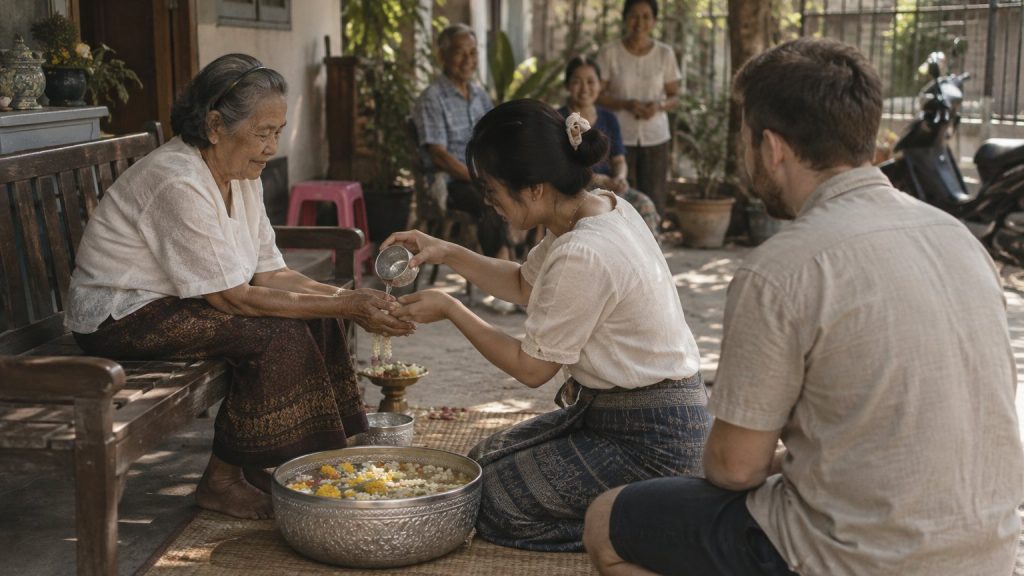
- Rod nam dam hua: younger members pour flower-scented water over the elders’ hands and are blessed 3.
- Cleaning and cooking: the house is cleaned and the family eats together.
- Water play: children and neighbours splash each other, and city streets close for water fights.
Not every family keeps all of these: customs differ by region, by faith and from house to house, so ask her which ones hers keeps. The rest of this page goes through each of these from the guest’s side: what it asks of you, and where to follow her. For Thai dating customs beyond the festival, see our guide to Thai dating culture.
Should you go home with her for Songkran?
If she asks you, it is worth taking seriously, and it is a choice you make together. In one thread, Thai posters told a man in a related spot to go. In a 2024 Pantip thread, a Thai man living in Bangkok asked what to do about his partner of about 12 years, who is from Chiang Mai and goes home every Songkran. Her reason, as he told it, was that she rarely gets to see her parents.
Of the 11 people whose answers we could code, 9 told him to go home with her. One suggested taking turns, her family’s Songkran one year and his family’s the next. One suggested staying in a hotel in town and visiting her family’s house for a day.